
Balance a Generous Sofa with Smaller Seats
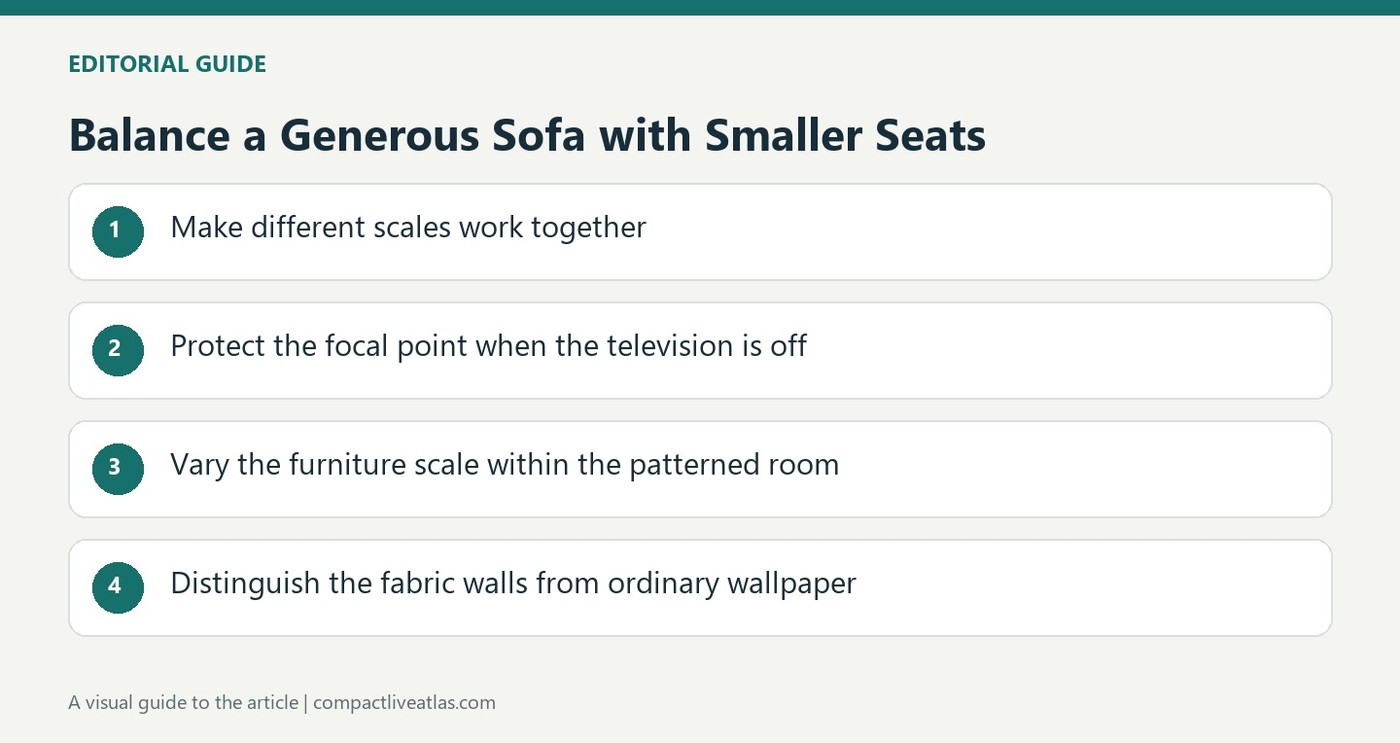
Make different scales work together
Phoebe Hollond's small living room combines a generous patterned sofa with smaller armchairs and an ottoman on visible legs. That contrast keeps the arrangement from becoming uniformly heavy. The source emphasizes establishing the room's functions early, then leaving enough separation between pieces for the layout to feel comfortable. Repeating selected colors across fabrics also helps the many patterns relate to one another instead of appearing unrelated.
Protect the focal point when the television is off
The television sits behind artwork above the mantel, so it disappears when not in use and leaves the fireplace as the room's visual center. This allows the same snug to support family viewing and entertaining without a permanent screen dominating the decoration. The approach involves a specific concealed installation, but its broader lesson is useful: technology should support the room's activities while the furniture, artwork, and architecture retain a coherent visual relationship.
Vary the furniture scale within the patterned room
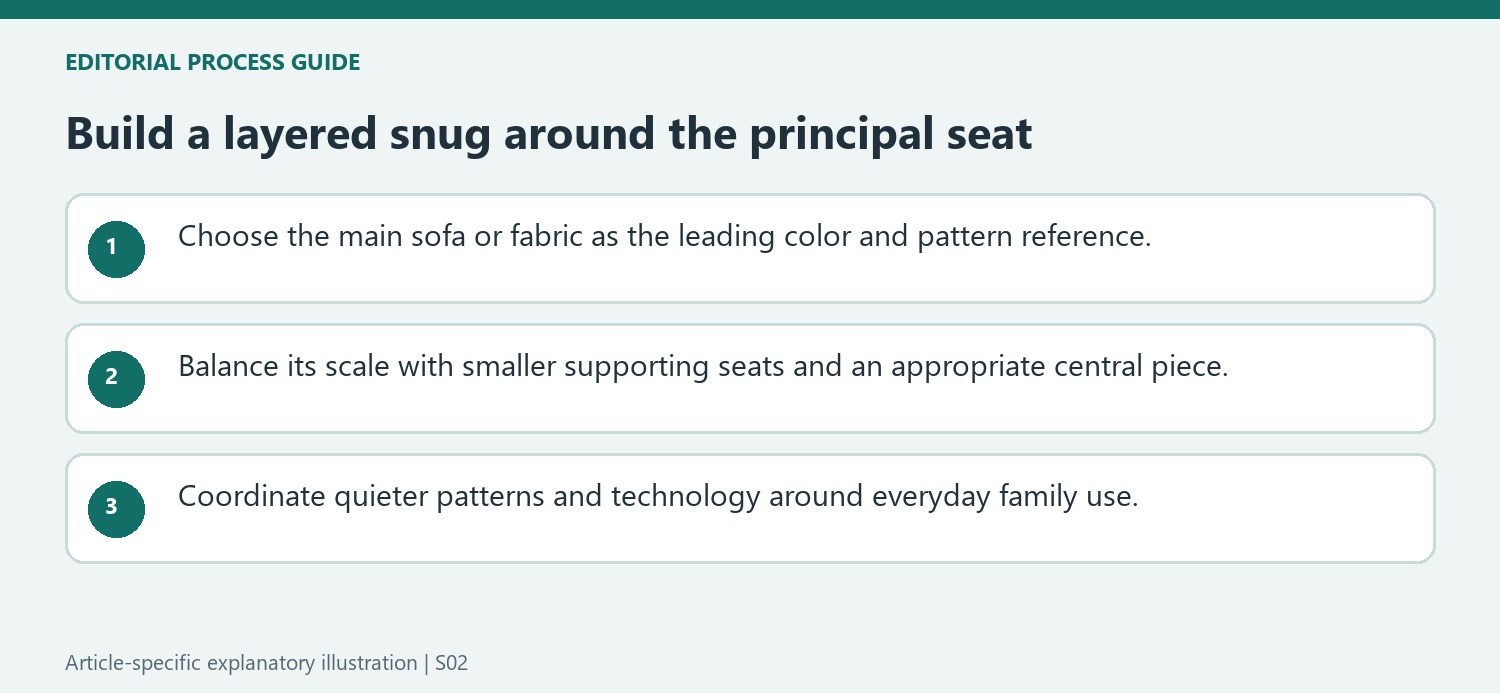
Phoebe Hollond combines a deep, generous sofa with smaller armchairs and an ottoman whose legs remain visible. That contrast allows the main seat to feel substantial without giving every object the same bulk. The sofa's pink and green fabric supplies a color reference, while differently scaled patterns repeat selected tones around it. A compact room therefore does not automatically require every piece to be equally small or plain.
Distinguish the fabric walls from ordinary wallpaper
The source describes striped fabric fitted over battens and wadding, with a scalloped top detail. This is a specific upholstered wall treatment, not simply a printed paper that will produce identical softness or installation requirements. The television is concealed behind artwork above the mantel, allowing the room's decorative focus to return when the screen is unused. Borrow those ideas according to the actual household activities and budget: repeated colors, an open-legged piece, or more deliberate screen placement can each contribute without reproducing the entire custom scheme.
Choose the dominant pattern before assembling the smaller ones
The sofa's pink and green Duchessina fabric leads Hollond's scheme, while the wall stripe supplies a more structured background. Smaller decorative prints then introduce variation without all demanding the same level of attention. An adaptation can begin with a retained patterned piece and identify a few colors already present in it. Compare those colors across samples at different scales rather than searching for an exact matching suite. The source describes an intuitive, collected approach, but also shows a clear hierarchy. If several large patterns all seem equally insistent, reducing one supporting element may make the dominant furnishing easier to read without removing the character that attracted the owner in the first place.
Use the sofa's generosity where it matters most
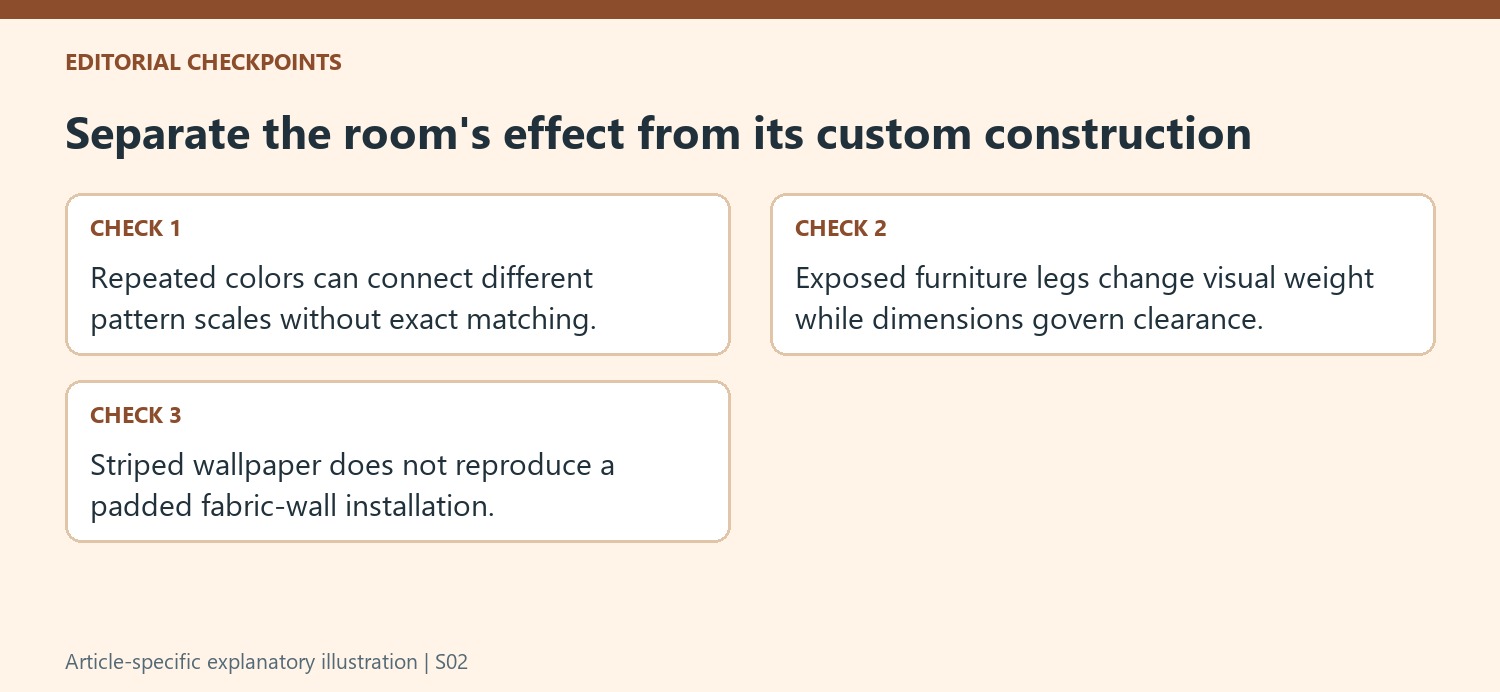
The deep sofa serves family lounging as well as entertaining, so its scale responds to a real priority. Smaller surrounding chairs and an open-legged ottoman keep the entire group from becoming uniformly substantial. That relationship does not mean any large sofa will fit a small room. Mark its depth, the usable approach, and the supporting seats together before comparing upholstery. A less frequently used chair may reasonably be more compact than the main family seat. The crucial decision is where comfort and floor area are most valuable, not whether every individual object qualifies as small. Visible legs influence the impression of openness while the actual dimensions still determine circulation.
Adapt the atmosphere without assuming the custom installation is necessary
Hollond's upholstered walls use battens and wadding beneath the striped fabric, and the television disappears behind artwork above the mantel. Both features belong to a carefully specified room. A striped wallpaper could provide a related graphic rhythm without reproducing the same padded construction; it should not be described as acoustically or physically identical. Similarly, moving or visually integrating a television can reduce its prominence without copying the concealed mechanism. Check any actual screen installation against equipment requirements and the viewing position. The room's broader lesson is that a strong fabric, varied furniture scale, and controlled technology can support both family use and a layered decorative identity when their practical relationships have been planned.
References
- This Designer's 'Almost Tent-Like' Pattern-Drenched Living Room Proves More is More in Small Spaces – IF You Get the Layout Right. Homes and Gardens; Charlotte Olby.
Phoebe Hollond's small living room combines a generous patterned sofa with smaller armchairs and an ottoman on visible legs.


Leave a Comment